Modularity and Circular Economy
Zhaga and sustainable lighting are transforming the industry, enabling more efficient and environmentally responsible lighting. The ability to upgrade and repair luminaires instead of replacing them entirely is gaining prominence, helping reduce waste and optimize resources.
Zhaga and Sustainable Lighting: Adaptable Design and Circular Economy
Traditional lighting solutions are often designed in such a way that, when a component fails or wears out, the entire luminaire must be replaced, which not only generates more waste but also increases maintenance costs. However, an approach based on modular design and interchangeable components allows only the essential parts to be replaced, significantly extending the luminaire's useful life and reducing both environmental impact and operational costs.
This approach is not only more sustainable but also aligns with the global Right to Repair movement, which promotes the creation of products that are easier and more accessible to repair. Adopting these principles in the lighting industry fosters a circular economy, where products are designed with repairability and upgradability in mind, resulting in reduced waste and more efficient use of resources.
This adaptable design model benefits not only manufacturers but also installers and end users, making maintenance easier and prolonging the life of installations.

If you want to learn more about Zhaga and sustainable lighting, check the official Zhaga website.
Zhaga and Sustainable Lighting: Standardization and Flexibility
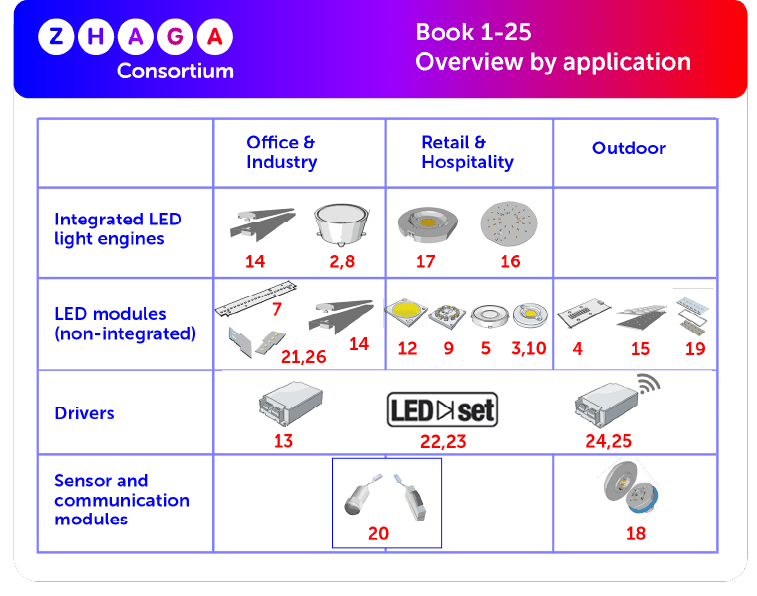
For this strategy to be viable, the different elements must be compatible with each other. This is where Zhaga makes a difference: it is a global consortium that standardizes interfaces for lighting components, ensuring that LED modules, drivers, sensors, and control systems can be replaced or upgraded with compatible components, regardless of the manufacturer.
Thanks to Zhaga and sustainable lighting, luminaires can be upgraded instead of replaced, reducing waste and optimizing their useful life. This standard allows them to be more versatile, easier to maintain, and scalable. Zhaga develops a series of technical specifications called “Books,” which define common interfaces for different components. For example, Book 20 facilitates the integration of sensors and communication nodes, while Book 26 standardizes replaceable LED modules, optimizing interoperability and extending the useful life of luminaires.
This drives more sustainable and future-ready lighting.
Zhaga and Digitalization: Technologies for Sustainable Lighting
Beyond physical design, connectivity plays a key role in the transition toward a more sustainable model. Technologies such as Near Field Communication (NFC) allow LED drivers to be configured and updated wirelessly, even after installation. This optimizes the management of luminaires throughout their lifecycle, facilitates maintenance, and reduces premature obsolescence.
European Regulations for Zhaga and Sustainable Lighting
The European regulatory framework is accelerating the adoption of these principles. The Ecodesign for Sustainable Products Regulation (ESPR) introduces requirements that promote resource efficiency, durability, and ease of repair in lighting systems.
Additionally, circular lighting regulations reinforce the obligation to enable the replacement of light sources and control equipment without discarding the entire installation.
Applying these principles benefits not only manufacturers but also installers, building owners, and public authorities. Key advantages include:
A Benefit for the Entire Industry and the Future of Lighting
Greater flexibility in the design and adaptation of luminaires.
Reduced costs in maintenance and upgrades.
Less waste thanks to component reuse.
Regulatory compliance with new circular economy rules.
With this approach, lighting moves toward a more sustainable and efficient model, where innovation and environmental responsibility go hand in hand.

LCE: Committed to a Sustainable Future
At LCE, as members of the Zhaga community, we are proud to be part of this movement toward more sustainable lighting. We work to provide LED solutions that meet the highest standards of quality, interoperability, and sustainability.
By integrating Zhaga principles into our products, we help our clients design and maintain lighting systems that are more efficient, upgradable, and easy to repair.
From our perspective, Zhaga and sustainable lighting are not just a trend, but a necessity for the future.
As a trusted partner, LCE is committed to providing components and systems that align with European regulatory requirements and best practices in the circular economy. Together, we move toward a more responsible and sustainable future in the lighting sector.
Sources: www.buildings.com / www.zhagastandard.org
The post Zhaga and Sustainable Lighting was first published on LCE LED.