After taking part in the lighting of the production Golfus de Roma, starring Carlos Latre, we are certain that one perfect application for LED lights is theatre lighting. Thanks to their versatility, design flexibility, and low energy consumption, LED lights are a lighting solution that meets a wide range of needs in a theatre.
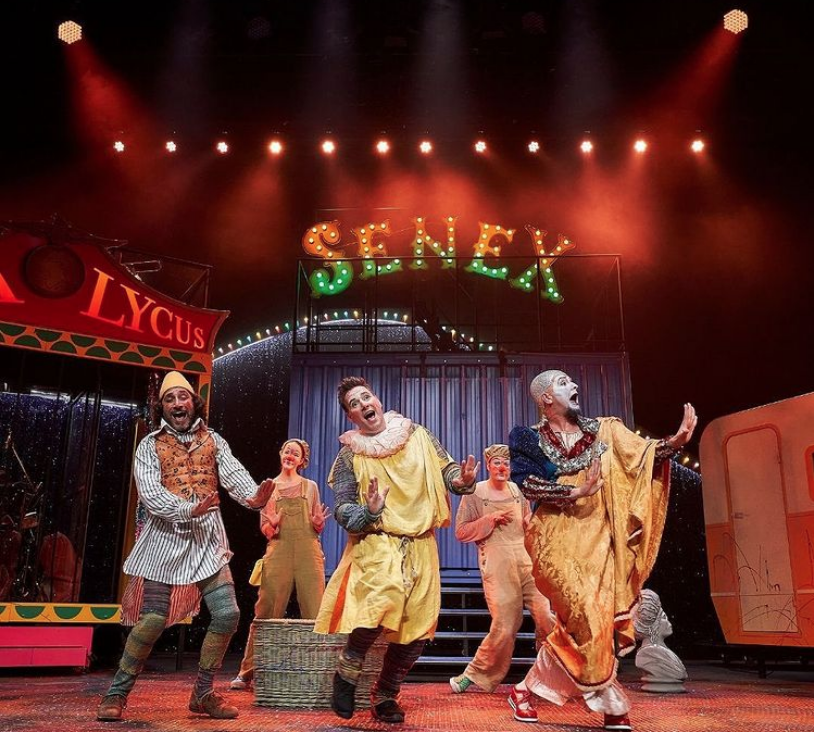
Applications of LED Theatre Lighting
When we talk about theatre lighting with LED lights, we are not only referring to stage scenery. LED lighting can be applied to several areas of a theatre that directly affect the overall experience of the audience:
- Exterior theatre lighting: Exterior theatre lighting using LED lights not only highlights the building itself, but also helps immerse the audience in the performance before it even begins. In these cases, color, light intensity, and even movement are perfect resources.
- Lighting of the lobby and the audience area: The design of these areas is very important and, above all, must fulfill the function of guiding and orienting visitors.
- Stage lighting: Stage lighting does not only improve visibility; it also supports the story being told. Stage lighting can be natural, to place the actions of the play in time, add nuance to the characters’ actions, and convey emotions. What is clear is that, in stage lighting, customization and adaptation of the luminaires to the needs of the performance are crucial.
- Projection of objects: To highlight objects or people on or off the stage, a powerful LED spotlight is ideal for illuminating and emphasizing these elements.
Functions and Properties of Theatre Lighting
Focusing on stage design, LED theatre lighting helps tell a story, establish the right atmosphere, and support the actions of the characters. In this respect, lighting has a strong influence on how the audience experiences the performance. In this way, lighting affects both actors and the audience, since without optimal lighting, actors would not perform at their best and the audience would not receive the full and proper experience.
In a theatrical production, the lighting designer must consider the four main functions of stage lighting: visibility, motivation (or the natural quality of the light), composition (considering lighting as part of the stage design), and atmosphere.
With a clear understanding of the role lighting plays in each scene, the technical aspects of integrating LED lighting into the performance must also be considered:
- Color
- Intensity
- Distribution
- Movement
By adapting the lighting properties to the function required at each moment, LED stage lighting becomes part of the storytelling itself, helping to convey the narrative.
Advantages of LED Lighting in Theatres
- Versatility: Thanks to their size and technical features, LED lights provide great versatility, making them ideal for theatre lighting.
- Low energy consumption: Compared to other light sources, LED lights are far more efficient, enabling energy savings that no other light source can match, while also reducing cabling requirements.
- Low voltage: As they are typically powered by 12V or 24V power supplies, overall safety is increased.
- Durability and reliability: Since LED lights have no filaments, they are highly resistant and can be handled easily, allowing for complex shapes and installation on a wide variety of supports.
- Dimmable: A very important feature for theatre lighting is the ability of LED lights to create countless colors and color temperatures, as well as both cool and warm white light.
If you would like more information or need guidance, please do not hesitate to contact us.